
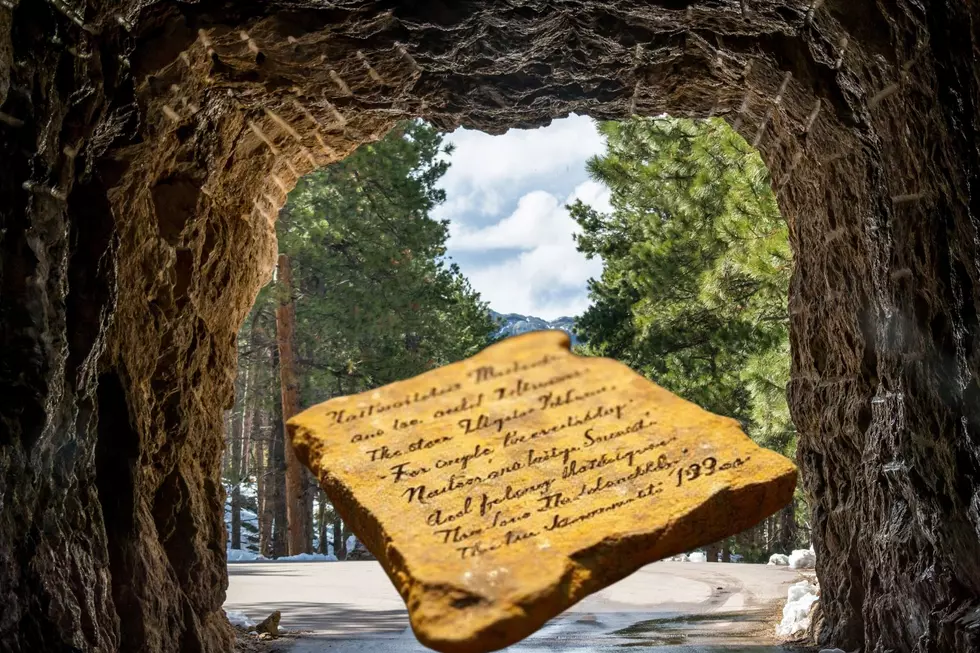
The Legendary South Dakota Gold Stone No One Can Explain
It's a stone that, if ever proven to be authentic, could rewrite the history books for the state of South Dakota. Yet, most who live within the state's borders have never even heard of it.
On March 14, 1887, two Norwegian immigrants, Louis and Ivan Thoen, were digging around Lookout Mountain in South Dakota's Black Hills when they struck a piece of sandstone. But this wasn't any old rock in the dirt. Written on it was a message from 1834—proof, according to the brothers, that pioneers had found gold in the area a full 40 years before the famous 1874 expedition of George Armstrong Custer.
But was the stone actually an authentic piece of Black Hills history, or one of the greatest hoaxes of its time?

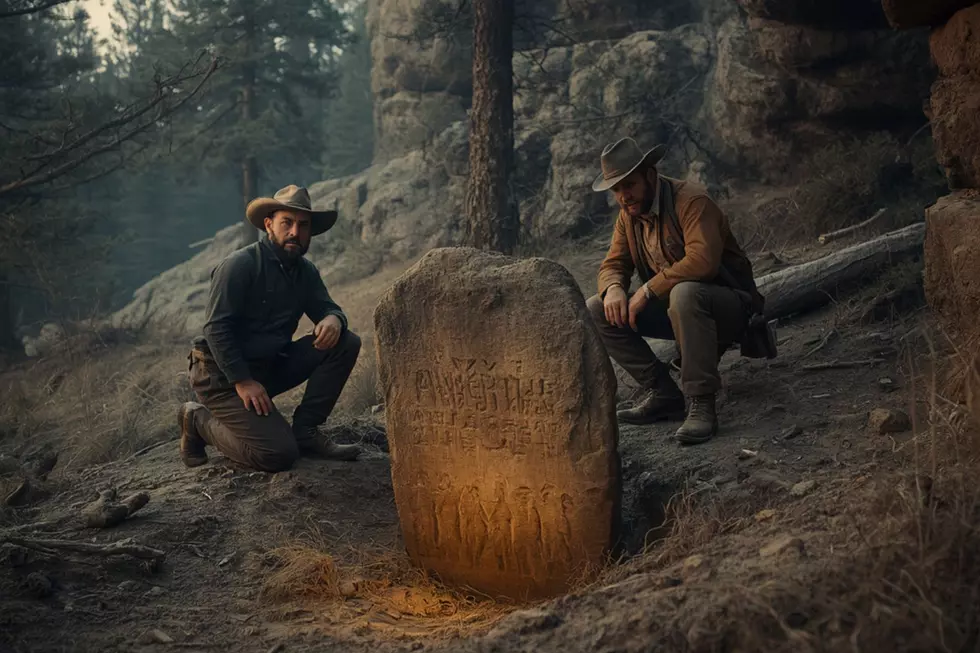
Back in 1887, when the stone was first unearthed, the entire Black Hills region was abuzz. Perhaps, most haunting, was the message written on the stone. The inscription reads:
FRONT
Came to these hills
in 1833 seven of us
De Lacompt
Ezra Kind
GW Wood
T Brown
R Kent
Wm King
Indian Crow
all dead
but me
Ezra Kind
Killed by Indians
beyond the
high hill got
our gold June
1834
BACK
got all of the
gold we could
carry our ponys
all got by the Indians
I have lost my gun
and nothing to
eat and Indians
hunting me
Both brothers would go on for the rest of their lives insisting the stone's authenticity. However, skeptics have pointed to numerous reasons as to why it could have been an elaborate hoax.
First off, Louis Thoen himself, just so happened to be a stonemason, making it quite a convenient discovery for him, at the time. Second, experts doubted that a man, who said he was running for his life, would've stopped to carve out such an elaborate message into the sandstone. Nevertheless, whatever information was out there saying the stone was a hoax was flimsy, at best.
Not to mention, there was also the account of a man named Harvey Brown Jr., who claimed his uncle left Michigan for the American west in 1832, and neither one was ever heard from again.
Going further, in the 1950s, an investigation by Spearfish historian Frank Thomson, found that several families out east claimed to have relatives who went out west in the 1830s, looking for gold. These family members showed letters that had been received by the ancestors around that time period from the men. Yet, all the family members who had been corresponding with their relatives out west, lost touch on the same year. 1834. The very same year inscribed upon the stone. Coincidence?
It's all still up for debate, but if ever authenticated, South Dakota history would, indeed, look very different.
You can learn more about the Thoen Stone and see it up close, at the Adams Museum, located at 54 Sherman Street in Deadwood, South Dakota.
South Dakota Is Home to World's Largest Pheasant
Gallery Credit: Randy McDaniel
More From KXRB